Bubbles — signal by topic
size = articles (7d) · editorials by Cayce158 articles in protocol — bigger & brighter = stronger signal
The Genesis Code audiobook is up, free on the site
Scaling Bitcoin with Swap Service Providers — Walter Maffione | bitcoin++ Berlin
Biggest Channel Opened Today (5.0 BTC) + New Node Spotlight (03dade0c8f0ab2f7a…)
Awards + Closing — Jake, niftynei | bitcoin++ Berlin, payments edition
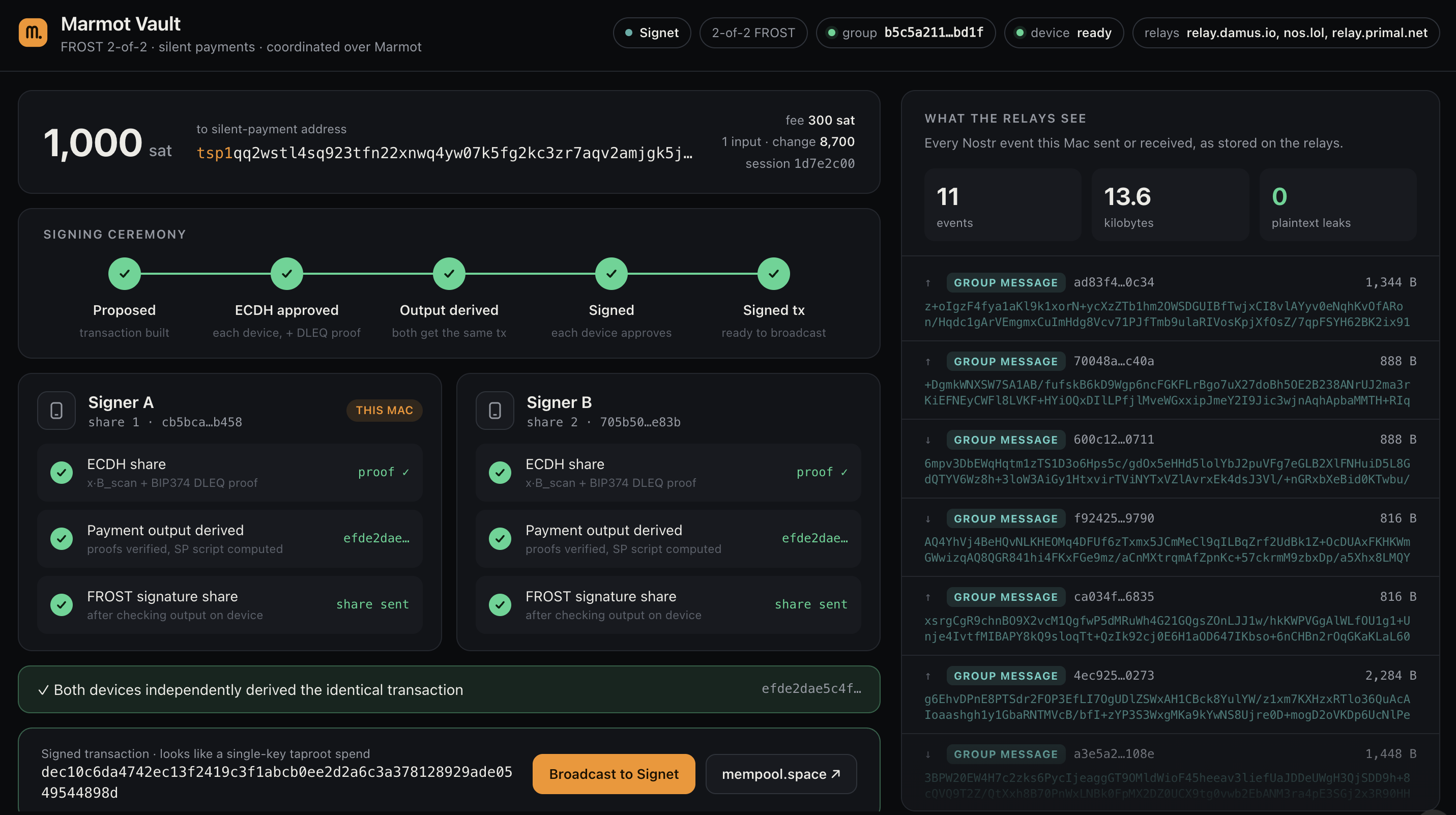
BlackIce: Distributed Frost Silent Payments · Hackathon · bitcoin++ seoul winner
The article celebrates 'BlackIce,' a project that emerged as a winner at the bitcoin++ Seoul hackathon. 'BlackIce' focuses on implementing 'Distributed Frost Silent Payments,' a significant advancement in Bitcoin privacy and security. This innovative solution combines FROST (Flexible Round-Optimized Schnorr Threshold) signatures with Silent Payments (BIP352). FROST is a threshold signature scheme that allows multiple signers to collaboratively produce a single, valid Schnorr signature, enhancing multisig setups by improving efficiency, security, and making them indistinguishable from single-signer transactions on the blockchain. Silent Payments, on the other hand, is a proposed Bitcoin privacy feature (BIP352) that enables recipients to publish a single, reusable address while still receiving payments to unique, unlinked addresses generated on the fly by senders, significantly reducing on-chain metadata leakage and improving transaction privacy. The 'BlackIce' project likely demonstrates a practical, distributed implementation of these cutting-edge protocol improvements, showcasing how they can work together to offer more robust and private transaction methods within the Bitcoin ecosystem. Its recognition as a hackathon winner underscores its technical merit and potential impact on Bitcoin user experience and protocol development.
What do you think of Bitcoin Core's AI contribution policy?

Bitcoin developer proposes ‘landmines’ to make quantum thieves lose their own BTC
A Bitcoin developer has put forward an innovative proposal, metaphorically termed 'landmines,' aimed at deterring and penalizing future quantum computing attacks targeting Bitcoin holdings. The core concept revolves around a mechanism designed to protect potentially vulnerable bitcoin from being stolen by quantum adversaries. Under this proposed system, any entity attempting to move bitcoin that is considered susceptible to quantum compromise would be required to commit a matching amount of their own collateral. The ingenious aspect of this 'landmine' strategy is that it provides a unique window of opportunity for the legitimate and prepared owners of these vulnerable bitcoins. Should a quantum thief initiate a move of such funds, the original owner, being aware of the 'landmine' protocol, would have the ability to claim not only their original bitcoin but also seize the collateral posted by the would-be quantum thief. This creates a significant disincentive for quantum attacks, transforming a potential theft into a costly endeavor for the attacker, and potentially a gain for the original owner who has prepared for such a scenario. This proactive security measure is a forward-thinking attempt by the Bitcoin development community to address hypothetical, yet potentially catastrophic, threats posed by advanced quantum computing capabilities against current cryptographic standards underpinning Bitcoin. It highlights ongoing efforts within the Bitcoin ecosystem to ensure long-term security and resilience against emerging technological challenges.

Bitcoin Optech Newsletter #430
Bitcoin Optech Newsletter #430 outlines key developments in the Bitcoin ecosystem, focusing on the continued discussion surrounding TCP hole punching. This technology aims to make Bitcoin nodes behind home routers more reachable, supplementing existing port forwarding methods, as default NAT-PMP in Bitcoin Core 30.0 did not achieve desired reachability. The initiative, led by 0xB10C, involves active work on a new specification and an experimental Bitcoin Core implementation. The primary goal is to increase the number of honest, reachable nodes, thereby making it more challenging for attackers to monopolize connection slots. A new coordinator-free design proposed by 0xB10C suggests nodes announce punchable addresses and temporary public keys in a new addr v2 type, with coordination derived from shared secrets and new blocks. Following concerns from Anthony Towns about potential flooding, an alternative "message board" approach is being explored, where listening nodes would curate verified addresses of home nodes looking for peers. Additionally, the newsletter discusses a draft BIP to standardize spending policies for co-signers when emulating covenants and covers regular updates on consensus rule changes, new releases, and infrastructure software.
Payjoin Trading: A Novel Approach to UTXO Consolidation and Privacy

Bull Bitcoin Becomes First Exchange to Add Payjoin Privacy Deposits, Withdrawals, and Payjoin-by-Default Trading
Bull Bitcoin has become the first Bitcoin exchange to fully integrate Payjoin technology, offering it as a default option for both deposits and withdrawals. This significant development means that every on-chain buy or sell transaction processed through Bull Bitcoin's BULL Wallet will now automatically utilize Payjoin. The implementation aims to enhance user privacy by obscuring transaction details from chain analysis, as well as providing tangible benefits such as automated UTXO aggregation. This process not only helps users reduce their future mining fees by consolidating inputs more efficiently but also contributes to a smaller overall Bitcoin UTXO set. The initiative was highlighted by Bitcoin Magazine, emphasizing its importance for advancing privacy within the Bitcoin ecosystem and streamlining on-chain operations for users.

Bitcoin Amsterdam 2026 | Day 1 Livestream
This article pertains to the 'Bitcoin Amsterdam 2026 | Day 1 Livestream,' indicating a live broadcast or recorded footage of the inaugural day of the annual Bitcoin Amsterdam conference. As a prominent global event dedicated exclusively to Bitcoin, the livestream would feature a comprehensive agenda covering the latest developments, insights, and discussions across the Bitcoin ecosystem. Viewers could expect to witness keynote speeches from leading Bitcoin developers, economists, and advocates, alongside panel discussions addressing critical topics such as advancements in the Bitcoin protocol, the evolution and adoption of the Lightning Network for faster payments, the macroeconomic implications of Bitcoin's rise, and evolving regulatory landscapes affecting the asset. The event also typically delves into areas like Bitcoin mining, self-custody best practices, privacy-enhancing technologies, and strategies for achieving financial sovereignty. The Day 1 livestream would likely capture opening remarks, foundational presentations, and significant announcements, setting the stage for the multi-day conference and providing invaluable signal for anyone interested in the future of Bitcoin.
BOLT12 Pay v0.3.20 — Now Available in Five Languages
Why Bitcoin's Next Soft Fork Could Feel Like a Practice Run
The article details Matt Corallo's perspective on an upcoming Bitcoin soft fork, highlighting its multifaceted importance beyond simple bug resolution. While the primary goal involves patching four legacy bugs crucial for ongoing Bitcoin maintenance, Corallo emphasizes that this soft fork also serves as a vital exercise in "rebuilding muscle memory" within the Bitcoin ecosystem. This suggests the process is not merely about technical fixes but also about reactivating and refining the community's processes for activating protocol upgrades. It acts as a critical practice run, preparing developers, node operators, and the wider community for potential future, more complex, or contentious protocol changes. This dual function ensures both immediate technical hygiene and long-term operational readiness for the Bitcoin network.
The Guy Who Put Names on Bitcoin | Just Another Naming System?
3d
Bitcoin++ Alerts — Know when the software you rely on changes

This transaction includes the whitepaper in its taproot annex
A notable Bitcoin transaction has recently occurred, embedding the original Bitcoin whitepaper directly within its Taproot annex. This event serves as a practical demonstration of the capabilities introduced by the Taproot protocol upgrade, which enhances the efficiency and privacy of data storage on the Bitcoin blockchain. The act of inscribing Bitcoin's foundational document using a significant protocol upgrade underscores the network's inherent immutability and censorship-resistance properties. This specific transaction not only creates a permanent, digitally timestamped record of the whitepaper but also highlights the technical flexibility and potential for diverse data inscriptions that Taproot enables, extending beyond conventional value transfers to encompass more complex data structures on-chain.

Nicholas Dorier: "Does BTCPay Server Still Serve a Purpose?"
The Genesis Code, Epilogue: What's Actually There

Liquid Network restores full bitcoin backing following $320 million exploit
The Liquid Network has confirmed that its bitcoin reserves have been fully re-established following a significant $320 million exploit that occurred in September. The necessary funds to restore the complete backing of bitcoin assets on the network were provided by Blockstream, a prominent company closely associated with the Liquid Network's development and operation. This restoration indicates the resolution of the security incident and ensures the continued solvency and integrity of the Bitcoin-backed sidechain.

Liquid Network Restores Full Bitcoin Backing Two Months After $320M Exploit
The Liquid Network, a notable Bitcoin sidechain, has successfully restored its full Bitcoin backing, two months following a significant exploit that resulted in a loss of approximately $320 million. Blockstream CEO Adam Back confirmed the completion of these recovery efforts, emphasizing that the sidechain's security infrastructure has undergone substantial improvements and its defenses have been significantly hardened. In a related warning, Back advised developers to exercise caution and avoid blindly trusting fixes or recommendations generated by artificial intelligence, underscoring the need for human vigilance and thorough verification in critical system development.

Liquid’s bitcoin IOUs are fully backed again after a $320 million exploit
The Liquid Network, a prominent Bitcoin sidechain, has successfully resolved the aftermath of a significant $320 million exploit that occurred in September. The incident had caused the network's L-BTC tokens, which represent bitcoin IOUs, to become unbacked. A final transfer of 250 BTC has now been completed, effectively closing the deficit and ensuring that all L-BTC are once again fully backed on a 1:1 basis with actual Bitcoin. However, the federation overseeing the Liquid Network has not yet revealed the identity of the party or parties who provided the necessary funds to cover the substantial hole created by the security breach.

Who Patches the Lightning Network? Evidence from Release Lines in Gossip
Cashu Nutshell 0.22.0: BIP-39 mint seeds, caching without Redis & security fixes
Bitcoin Optech Newsletter #429 Recap Podcast
The Bitcoin Optech Newsletter #429 Recap Podcast provides a deep dive into the latest developments and security updates across the Bitcoin ecosystem. The discussion, featuring prominent contributors, highlights key news such as silent payments for multiparty wallets, designed to enhance privacy and efficiency for collaborative transactions. A significant point was the disclosure and resolution of a self-referential channel announcement DoS vulnerability in Core Lightning (CLN), along with an update to Bitcoin Core's security policy, reinforcing the commitment to robust network defenses. Technical queries from Bitcoin Stack Exchange were addressed, including the difference between transaction IDs and witness transaction IDs, methods for signing MuSig transactions using Bitcoin Core, and a breakdown of changes in Bitcoin P2P protocol versions 70016 and 70017. The podcast also detailed several recent releases and release candidates, including Bitcoin Core versions 32.1, 31.2, 30.4, and 29.5, as well as updates for major Lightning Network implementations like Eclair 0.14.6 and LND v0.21.5-beta. Specific notable code and documentation changes were reviewed, referencing critical pull requests for Bitcoin Core (#36665, #36667, #36669), Bitcoin Improvement Proposals (BIPs #2130), Core Lightning (#9627), and Eclair (#3417), collectively underscoring continuous innovation and maintenance efforts in the Bitcoin and Lightning protocol layers.
loading payment rails…